I have been a fan of planks for years. Seven years ago when I started my fitness journey, planks were the first-ever challenge that I accepted.
So, I am an old dog learning new and trendy tricks while having fun.
Yes, this excruciating challenge was fun for me, even though I hated it dearly.
The pleasure is in suffering, you just have to find the suffering you are willing to endure for the ultimate pleasure.
Week 1:- Cursing makes exercise easier
I have 5 years of yoga training under my belt. I practice zen yoga flow daily. Deep breaths, empowering thoughts, and a clear mind is my definition of a good workout.
But it changed when I started this challenge. I lost my cool and became a sailor yelling and cussing just to get through this challenge.
The first week was tough, and my ego made it even worse. I am a yoga trainer so I aimed to do the five minutes without any break. It was a mistake, that I made willingly.
Important:- Don’t be a fool like me, accept your limitations, and take a break. I know the right posture for plank, I have taught it to many people over the years. I maintained the correct posture even when I wanted to quit.
But if you are a beginner there is a higher chance you will end up in the wrong posture and hurt yourself. So, stop and take a break.
Week 2:- Remember to Breathe
Breathing is the principle of yoga. All the poses are performed in synchronization with the breath. So, you would think I would remember to do it while planking.
Turns out I am not so smart after all. I often forgot to breathe while holding the plank. I would take a deep breath while changing the plank position but not so much while holding them.
The right breathing technique can every exercise easier. In the second week, I worked on breathwork, it was way more difficult than maintaining the right posture.
Get in the plank position and take a long deep breath(4 seconds in) and then exhale it in 4 counts. Don’t hold your breath while performing a plank, it will make it difficult for you to focus on the posture.
Take a deep breath, exhale and repeat.
Week 3:- Development of Mind-Muscle Connection
Here is a fun fact, all planks variations are actually yoga poses. In yoga, we are trained to develop a mind-muscle connection.
Mind-muscle connection means when you are deliberately thinking about the exercise. You are fully focused on the present moment.
I applied this same formula while doing this challenge. I paid full attention to my form and breathing.
I was aware of how my muscle ached every time I changed a variation. Creating awareness about how your body reacts to an exercise can help you maximize your gains.
Like I knew when I stopped breathing, I was aware of my posture at all times, and I was aware of how my core contracted. This mind-muscle connection is crucial for every exercise.
Week 4:- Synchronised Performance
In the ending week, this challenge became easier. I was able to perform it without any cussing. And deep breathing became second nature.
By this week I have already witnessed some changes so it motivated me to keep going on and finish strong.
I had choreographed the perfect 5-minute plank routine that I can do with almost no breaks.
I also added a few new variations to keep things interesting.
The Benefits I experienced
Planks activate more muscles than you can count. In 38 days, I noticed these health improvements.
Stronger core
Planks are the new crunches. There is no need to crunch if you follow a planking routine. Plank is an isometric exercise that tones your abs and obliques.
Have some mercy on your lower back and join the pro fitness camp by starting a planking regime.
Lower back stability
I have had a cervical scare in the past, so I know the troubles that come from sitting 8 hours a day.
Planks are a great strength-building exercise that will tone your upper back muscles properly.
Toned butt
You can tone and strengthen your glute muscles while planking. Focus on your glutes when you plank.
Make sure to squeeze them tight when planking. It will help you stabilize and activate your glute muscles.
No more noodle arms
This is a no-brainer. While planking you manage your body weight on your arms so these muscles get special attention.
If you suck at push-ups or pull-ups then planks are the best way to increase upper body strength.
Full body strengthening workout
Planks are a full-body workout. They will work your back, arms, glutes, abs, obliques, and even neck muscles.
You can avoid many physical ailments by doing this simple exercise.
The right posture to hold a plank
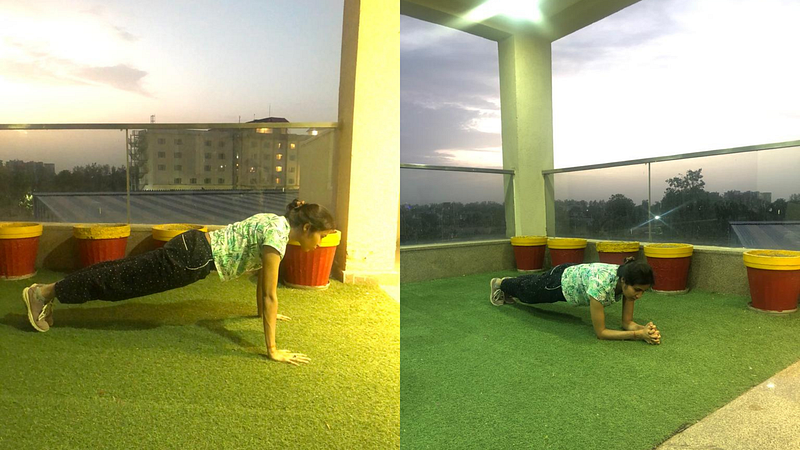
The easiest way to know if you are holding a plank right is by checking if your body is in a straight line.
Place your hands right under the shoulders, keep your core tight, and your hips straight.
Make sure that your hips are not drooping. As it can cause you excruciating back pain.
If you are doing a plank for the first time, managing your weight, and keeping your hips in a straight line could be challenging. So, you can keep your hips a little higher to make the plank easier.
Why you should always aim for the right posture
Performing plank in the wrong posture can cause many health problems:-
- It can lead to inflammation of the cartilage that connects the ribs to the breastbone.
- It can cause a strain on the pectoral muscles.
- Dipping your fanny while planking can lead to back pain.
- The wrong posture can also lead to neck and cervical pain.
The Plank Variations
The basic workout consisted of five planks that I held for one minute each.
1. High Plank
Start in all four positions with your wrist placed right under your shoulders and your knees under your hips. Straighten your knees and push your toes into the mat.
Keep your hips high. And distribute your weight evenly on your hands and feet.
2. Forearm Plank
Descend from a high plank by placing your elbows on the ground and keeping your hands right under your shoulder.
Keep your toes firmly planted on the ground and your hips high. Hold this position for one minute.
3. Side-Plank
There are two ways you can do the side plank.
The beginner version:- Get in the high plan position and tilt your weight on the right side. Balance the plank on one hand and foot.
The Advanced position:- Get in the forearm plank position and tilt your weight on the right side. Balance the plank on one elbow and foot.
Keep your shoulders straight and hips lifted. Distribute weight evenly on both the hand or elbow and foot. Hold one minute on both sides.
4. Back Plank
Sit on the mat with your legs straightened in front of you, and put your hands by your hips. Lift yourself up and balance your weight on your hands and heel.
Hold this pose for one minute.
Disclaimer
I have been doing planks for the past seven years, so holding a plank for five minutes straight was not overtraining for me.
I have trained my body for this challenge. But if you are a fitness beginner, then there is a chance this workout could be taxing for you.
So, modify this workout so that you don’t overtrain. Overtraining is the leading cause of many fitness-related injuries.
So, start small and follow this 2.5-minute plank workout that I used to do as a beginner.
Conclusion
Planks are a great challenge if you want to level up your fitness game. This experience increased my motivation to move daily.
On rest days I would go for a long walk, and stretch a little to warm up for this challenge. It helped me exercise regularly.
This challenge was difficult but worth it. If you want to get a tighter and stronger core then planks are the way to go.